16 Best Germany Christmas Markets to Visit in 2026 (With Dates)
This guide explores the 14 best German Christmas markets for 2026, with tips, routes, food to try, and advice on staying connected with Jetpac eSIM for Germany.

Christmas markets are one of Germany's oldest seasonal traditions. In 2026, most of them run from mid to late November until 23 or 24 December. A few, including markets in Berlin, Düsseldorf, Dortmund and Lübeck, stay open until the end of December or into early January.
Almost every German town holds a Weihnachtsmarkt, but some stand out for their history, setting and food. Examples include Dresden's Striezelmarkt, first recorded in 1434, the market beneath Cologne Cathedral, and Nuremberg's Christkindlesmarkt with its small grilled bratwurst. This guide covers 16 of the best Christmas markets in Germany. For each one you'll find the 2026 dates, what to eat, typical prices, and simple train routes for seeing several markets in one trip. If you're still choosing between countries, our guide to the best places to travel in Europe in December compares the main options.
Germany Christmas market dates 2026
Market | City | 2026 dates |
|---|---|---|
Cologne Harbour Christmas Market | Cologne | 13 Nov – 23 Dec |
Cathedral Christmas Market | Cologne | 16 Nov – 23 Dec |
Weihnachtsmarkt | Dortmund | 19 Nov – 30 Dec |
Christkindlmarkt, Marienplatz | Munich | 20 Nov – 24 Dec |
Reiterlesmarkt | Rothenburg ob der Tauber | 20 Nov – 23 Dec |
Weihnachtsmarkt | Aachen | 20 Nov – 23 Dec |
Christmas markets | Düsseldorf | 20 Nov – 30 Dec |
Römerberg market | Frankfurt | 23 Nov – 22 Dec |
Weihnachtsmarkt | Heidelberg | 23 Nov – 22 Dec |
Historischer Weihnachtsmarkt, Rathausmarkt | Hamburg | 23 Nov – 23 Dec |
Weihnachtszeit at the Rotes Rathaus | Berlin | 23 Nov – 3 Jan |
Lübecker Weihnachtsmarkt | Lübeck | 23 Nov – 30 Dec |
Weihnachtsmarkt | Leipzig | 24 Nov – 23 Dec |
Weihnachtsmarkt, Domplatz | Erfurt | 24 Nov – 22 Dec |
Striezelmarkt | Dresden | 25 Nov – 24 Dec |
Weihnachtsmarkt | Stuttgart | 25 Nov – 23 Dec |
Christkindlesmarkt | Nuremberg | 27 Nov – 24 Dec |
Opening hours vary by market and by day. Markets that open on 24 December usually close by early afternoon. Nuremberg, for example, closes at 2pm on Christmas Eve.
When do Christmas markets in Germany open and close?
The season starts earlier than many visitors expect. In 2026, Cologne's harbour market opens on 13 November and the cathedral market follows on 16 November. Most other large markets open between 20 and 27 November. Nuremberg opens on the Friday before the first Sunday of Advent.
Most markets close on 23 December or at lunchtime on 24 December, because Germans spend Christmas Eve at home. Avoid planning a trip between Christmas and New Year if the markets are your main reason for going. A few markets do continue after Christmas:
- Düsseldorf, Dortmund and Lübeck run until 30 December.
- Berlin's Gendarmenmarkt runs until 31 December.
- The market at Berlin's Rotes Rathaus stays open until 3 January.
Early December is usually the best time to go. All markets are open, the atmosphere is festive, and crowds are lighter than in the final two weekends before Christmas. Weekday evenings are noticeably quieter than Friday and Saturday nights.
The tradition itself goes back to medieval winter markets, where townspeople stocked up on food and supplies before the cold months. Frankfurt dates its market to 1393 and Dresden's Striezelmarkt was first recorded in 1434, which makes them among the oldest in the country. For how other countries mark the season, see our guide to Christmas traditions around the world.
16 best Christmas markets in Germany for 2026
1. Nuremberg Christkindlesmarkt
Where: Hauptmarkt | 2026: 27 Nov – 24 Dec | Try: Nuremberg bratwurst, Lebkuchen
Nuremberg's market is one of the most famous in the world and dates back to the mid-16th century. It is known as the "little city of wood and cloth" for its red-and-white striped stalls. Each year the Christkind, a figure in gold who presides over the market, opens the season with a prologue read from the church balcony. Look for Nuremberg Lebkuchen (gingerbread), the small bratwurst served three in a roll, and the figures made from dried prunes, a local speciality. Evenings and weekends are very busy, so go on a weekday morning if you want time at the craft stalls.
2. Dresden Striezelmarkt
Where: Altmarkt | 2026: 25 Nov – 24 Dec | Try: Dresdner Christstollen
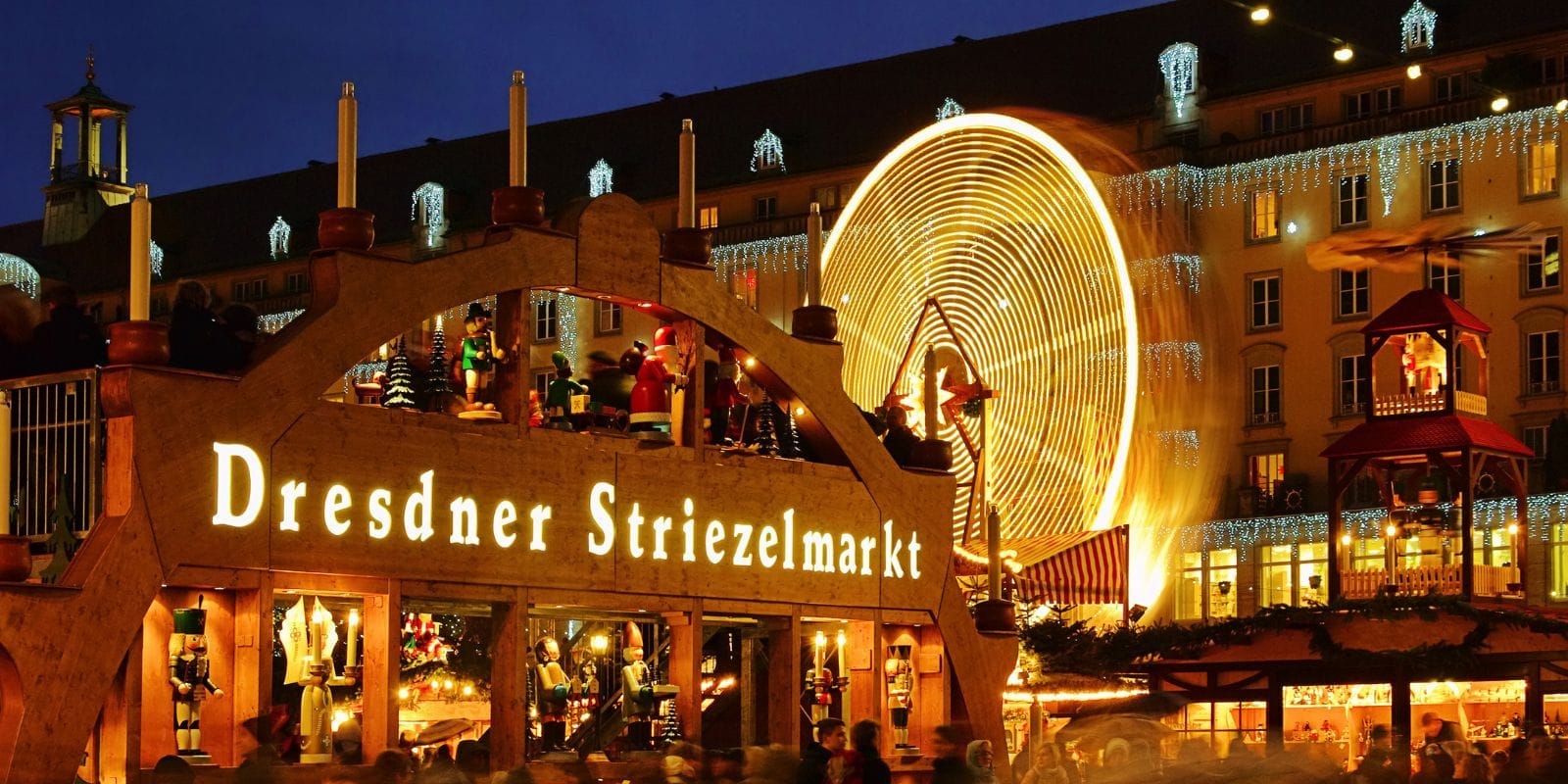
The Striezelmarkt has been held since 1434 and is one of the best-known markets in Germany. It has more than 200 stalls. Its centrepiece is a 14.62-metre Erzgebirge step pyramid, which has held a Guinness record since 1999. Stollen is the thing to buy here, and the Stollenfest weekend in December is the most traditional time to visit. Saxon wood carvings, candle arches and Pflaumentoffel (prune figures) make good souvenirs.
3. Cologne Christmas markets
Where: Roncalliplatz, beside the cathedral | 2026: 16 Nov – 23 Dec | Try: Reibekuchen (potato fritters)
Cologne's cathedral market is among the busiest in the country, with around 150 stalls and more than four million visitors a year. A star-shaped canopy of lights hangs above the stalls, and a large Christmas tree stands in the centre. Cologne also has several other markets within walking distance:
- Harbour market (13 Nov – 23 Dec): on the Rhine, next to the Lindt Chocolate Museum.
- Heinzels Wintermärchen: at Heumarkt and Alter Markt, with one of Europe's largest outdoor ice rinks.
- HEAVENUE (16 Nov – 23 Dec): the city's LGBTQIA+ market, which has moved to the Belgian Quarter for 2026.
Go during the week if you can, because weekends are crowded.
4. Munich Christkindlmarkt
Where: Marienplatz | 2026: 20 Nov – 24 Dec | Try: Feuerzangenbowle, roasted almonds
Munich's main market has roots in the 14th century and has been held on Marienplatz, in front of the neo-Gothic New Town Hall, since 1972. It includes one of Germany's largest nativity markets, and the square has a 25-metre Christmas tree. Live Stubenmusik (traditional folk music) is played most evenings. Krampuslauf parades, where costumed figures from Alpine folklore walk through the crowds, take place during Advent. Munich also hosts Pink Christmas, an LGBTQ+ market. For the rest of your stay, see our list of things to do in Munich.
5. Berlin Christmas markets
Where: Rotes Rathaus, Gendarmenmarkt, Charlottenburg Palace and more | 2026: Rotes Rathaus 23 Nov – 3 Jan | Try: garlic potato chips
Berlin has more than 60 Christmas markets, so it's best to choose one or two based on what you want.
- Rotes Rathaus: between the Red Town Hall and St Mary's Church, with an ice rink and a Ferris wheel. It runs into January.
- Gendarmenmarkt: known for quality crafts. It stays open until 31 December.
- Charlottenburg Palace: has a wider choice of food.
The markets are spread across different neighbourhoods. Our guides on things to do in Berlin and using public transport in Berlin will help you plan the time between them.
6. Stuttgart Weihnachtsmarkt
Where: Schlossplatz, Schillerplatz and Marktplatz | 2026: 25 Nov – 23 Dec | Try: Swabian specialities
Stuttgart's market goes back to at least 1692 and has nearly 300 wooden stalls. Many stallholders compete to decorate their roofs with elaborate scenes, which is worth seeing in itself. More than 60 choir and music performances take place during the season, and the town hall is turned into a giant Advent calendar. The walkways are wide, so it rarely feels cramped even at busy times.
7. Hamburg Rathausmarkt and Santa Pauli
Where: Rathausmarkt | 2026: 23 Nov – 23 Dec | Try: Glühwein and Hamburg pastries
Hamburg's Historischer Weihnachtsmarkt stands in front of the city hall and has around 80 stalls focused on crafts. The highlight is the Flying Santa, who passes over the market in his sleigh three times a day. Santa Pauli, close to the nightlife district, is the city's adults-oriented alternative. It pairs well with a day trip to Lübeck.
8. Rothenburg ob der Tauber Reiterlesmarkt
Where: Marktplatz and surrounding squares | 2026: 20 Nov – 23 Dec | Try: Schneeballen (a local pastry)
Rothenburg's market dates back to the 15th century. It is named after the Reiterle, a horseman from Germanic legend. With 61 stalls, it is much smaller than the city markets, but the medieval old town makes it one of the most attractive. Every evening during Advent, a new Advent window is opened at the town hall. The windows are designed by local school classes and youth groups. Stay overnight if you can, because the town is quiet once the day visitors leave.
9. Frankfurt Römerberg Christmas Market
Where: Römerberg to Paulsplatz and the Main riverbank | 2026: 23 Nov – 22 Dec | Try: Bethmännchen, hot apple wine
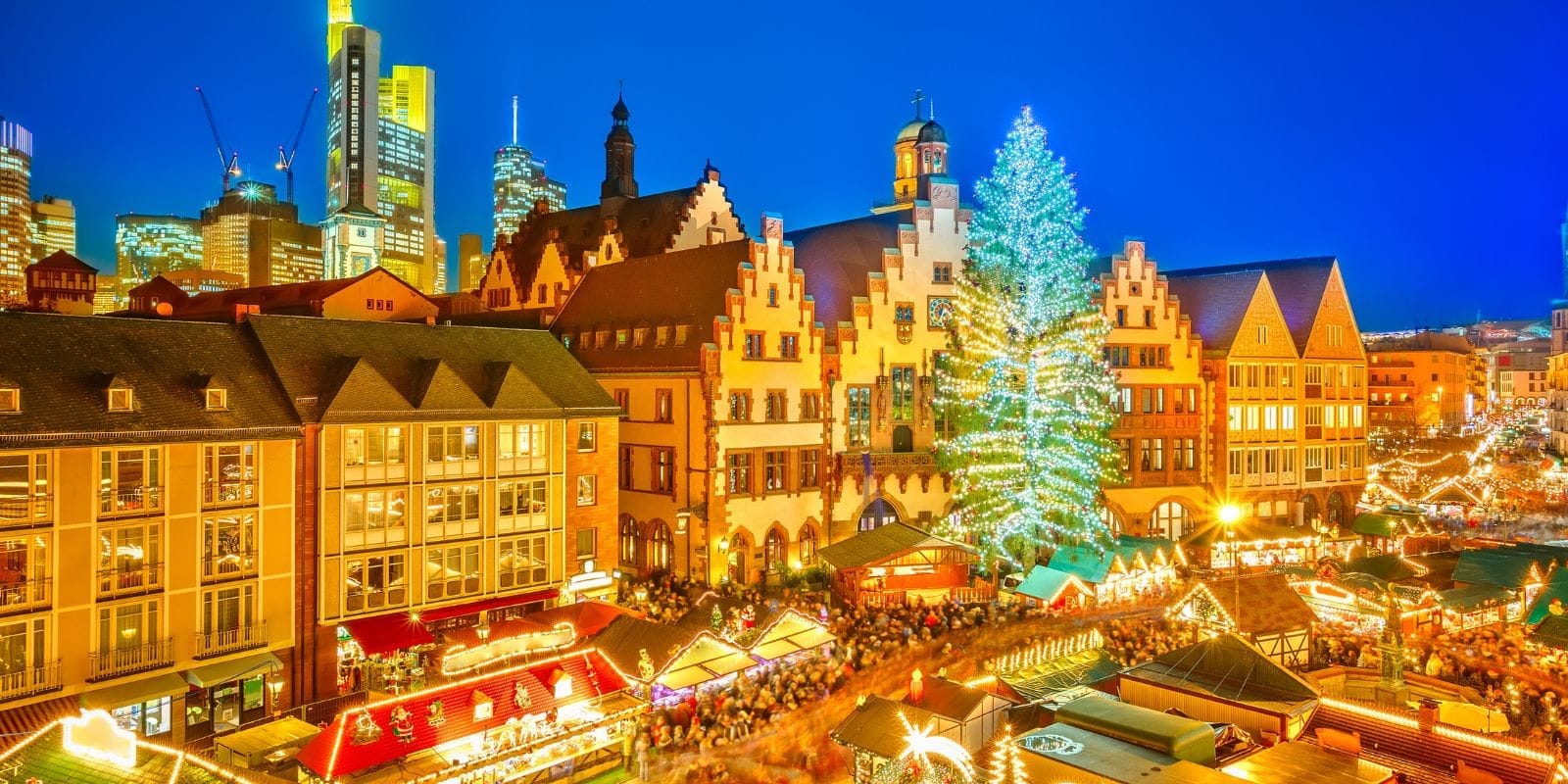
Frankfurt dates its market to 1393, which makes it one of the oldest in Germany. More than 200 stalls stretch from the old town square towards the River Main, and a large Christmas tree stands on the Römerberg. Try Bethmännchen, small marzipan pastries topped with almonds, and hot apple wine instead of Glühwein. Frankfurt is a major rail and air hub, so it is a practical first or last stop.
10. Leipzig Christmas Market
Where: Markt and the old town | 2026: 24 Nov – 23 Dec | Try: Leipziger Lerche (a marzipan pastry)
Leipzig's market dates back to 1458. It has around 300 stalls spread across the old town and draws about 2.8 million visitors a year. Highlights include traditional crafts from the Ore Mountains, a nativity scene with live animals, and a Finnish village. The sections each have a different style, so plan to spend a few hours here.
11. Lübeck Christmas markets
Where: Old town, around the town hall and St Mary's Church | 2026: 23 Nov – 30 Dec | Try: Lübeck marzipan
Lübeck calls itself the Christmas city of the North and has recorded a Christmas market since 1648. Its markets spread across the UNESCO-listed old town:
- Main market: at the town hall.
- Historic market: in the churchyard of St Mary's, where craftspeople demonstrate old skills.
- Maritime market: on the Koberg, in the old seafarers' quarter.
Marzipan is the local speciality. The markets are 15 to 20 minutes' walk from the main station.
12. Heidelberg Christmas Market
Where: Six squares in the old town | 2026: 23 Nov – 22 Dec | Try: Glühwein with a view of the castle
Heidelberg's market has more than 140 stalls spread over six squares, with the castle on the hill above. The ice rink on Karlsplatz has the best view of the castle. It is a popular day trip, so afternoons can be busy. It is still easier to manage than the large city markets, and it suits travellers who want a scenic market without huge crowds.
13. Aachen Christmas Market
Where: Around the cathedral and town hall | 2026: 20 Nov – 23 Dec | Try: Aachener Printen
Aachen's market has been held for more than 50 years. Its stalls surround the 1,200-year-old cathedral, a UNESCO World Heritage Site where Charlemagne is buried. Printen, a hard spiced gingerbread, is the local speciality and travels well as a gift. Visitors often find prices here a little lower than in bigger cities. Aachen sits on the borders of Belgium and the Netherlands. If you cross between countries, an eSIM that works across Europe saves you from switching plans at the border.
14. Erfurt Christmas Market
Where: Domplatz, extending to Fischmarkt and Anger | 2026: 24 Nov – 22 Dec | Try: Thuringian Rostbratwurst
Erfurt's market is set beneath the cathedral and the Church of St Severus. The 2026 edition is the 176th. It has more than 200 wooden huts, a 25-metre Christmas tree, a 12-metre Christmas pyramid and an almost life-size hand-carved nativity scene. The Domplatz is spacious, so it stays comfortable even when busy. Erfurt station is an ICE hub between Berlin and Munich. From the station, the market is a 15-minute walk or a short tram ride on lines 3, 4 or 6.
15. Düsseldorf Christmas markets
Where: Old town, Königsallee and Schadowplatz | 2026: 20 Nov – 30 Dec | Try: Glühwein and Reibekuchen
Düsseldorf has several themed markets within walking distance of each other, which makes it easy to see a few in one evening:
- Märchen-Markt (Schadowplatz): huts topped with characters from the Brothers Grimm fairy tales.
- Heinrich-Heine-Platz: known for its angel decorations.
- Königsallee: becomes "Kö-on-Ice" for the season.
The markets run until 30 December, which helps if your trip extends past Christmas.
16. Dortmund Christmas Market
Where: City centre, across ten locations | 2026: 19 Nov – 30 Dec | Try: the annual collectible Glühwein mug
Dortmund's market is one of the largest in Europe. It has more than 250 stalls and around 3.6 million visitors a year. Its tree is 45 metres tall and lit with 138,000 LEDs, and the city bills it as the largest Christmas tree in the world. Dortmund is close to Düsseldorf and Cologne, and its market stays open until 30 December.
How to plan your Christmas market route
The simplest approach is to focus on one region. Pick one or two base cities and take day trips by train, rather than trying to cover the whole country. Distances stay short, you change hotels less often, and you still see variety between big-city and small-town markets. These groupings work well:
- Munich → Nuremberg → Rothenburg: a major city market combined with two of the most traditional ones.
- Cologne → Aachen → Düsseldorf → Dortmund: four markets close together in the west, with frequent trains.
- Dresden → Leipzig → Erfurt: eastern Germany's historic markets, all on good rail connections.
- Hamburg → Lübeck: an easy northern pairing.
Small towns are worth including. They have shorter walking distances, fewer crowds and more regional food, and Germans often prefer them to the big-name markets. Our guide to the best places to visit in Germany covers more towns to add.
Getting around by train. Trains are the best way to travel between markets, but build in buffer time, because Deutsche Bahn delays are common. Here are the main ticket options:
- Regional trips: The Deutschlandticket costs €63 a month and covers all local and regional trains, buses and trams, but not ICE or IC services. It is a subscription that renews automatically, so cancel it after buying.
- Longer journeys: Compare saver fares on bahn.de with the German Rail Pass, Eurail or Interrail. Reserve seats on ICE trains in December, because they fill up.
- More detail: Our guides on how to book train tickets in Europe and train travel across Europe cover the booking steps.
Getting there. From the UK, Eurostar connects London St Pancras to Cologne in about five and a half hours, with a change in Brussels. See travelling to Europe from the UK for more options. Visitors from the US can read our guide to traveling to Germany from the US.
What to eat, drink and buy
Drinks. Glühwein (mulled wine) is served at every market. Kinderpunsch is the non-alcoholic fruit punch, and Feuerzangenbowle is a rum-soaked sugar cone set alight over mulled wine. When you buy a drink, you pay a deposit called Pfand for the mug, usually €2 to €5. Return the mug for a refund, or keep it as a souvenir, since most cities release a new design each year.
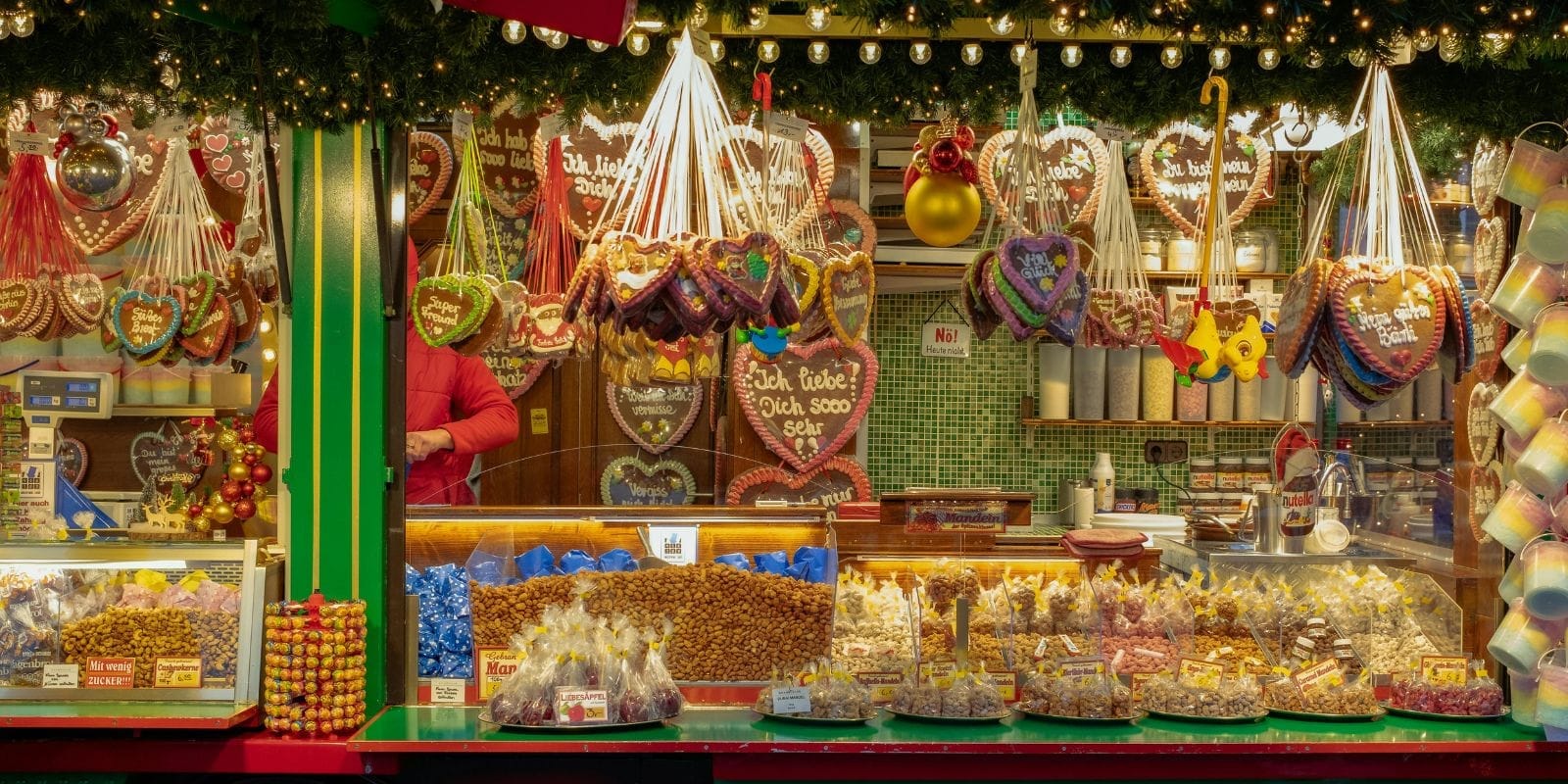
Food. Start with the basics: bratwurst, Reibekuchen (potato fritters), roasted almonds and Lebkuchen. Then look for the regional dishes:
- Nuremberg: small bratwurst
- Dresden: stollen
- Aachen: Printen
- Frankfurt: Bethmännchen
- Lübeck: marzipan
- Erfurt: Thuringian Rostbratwurst
A good rule is that any food named after the town is the local version worth trying.
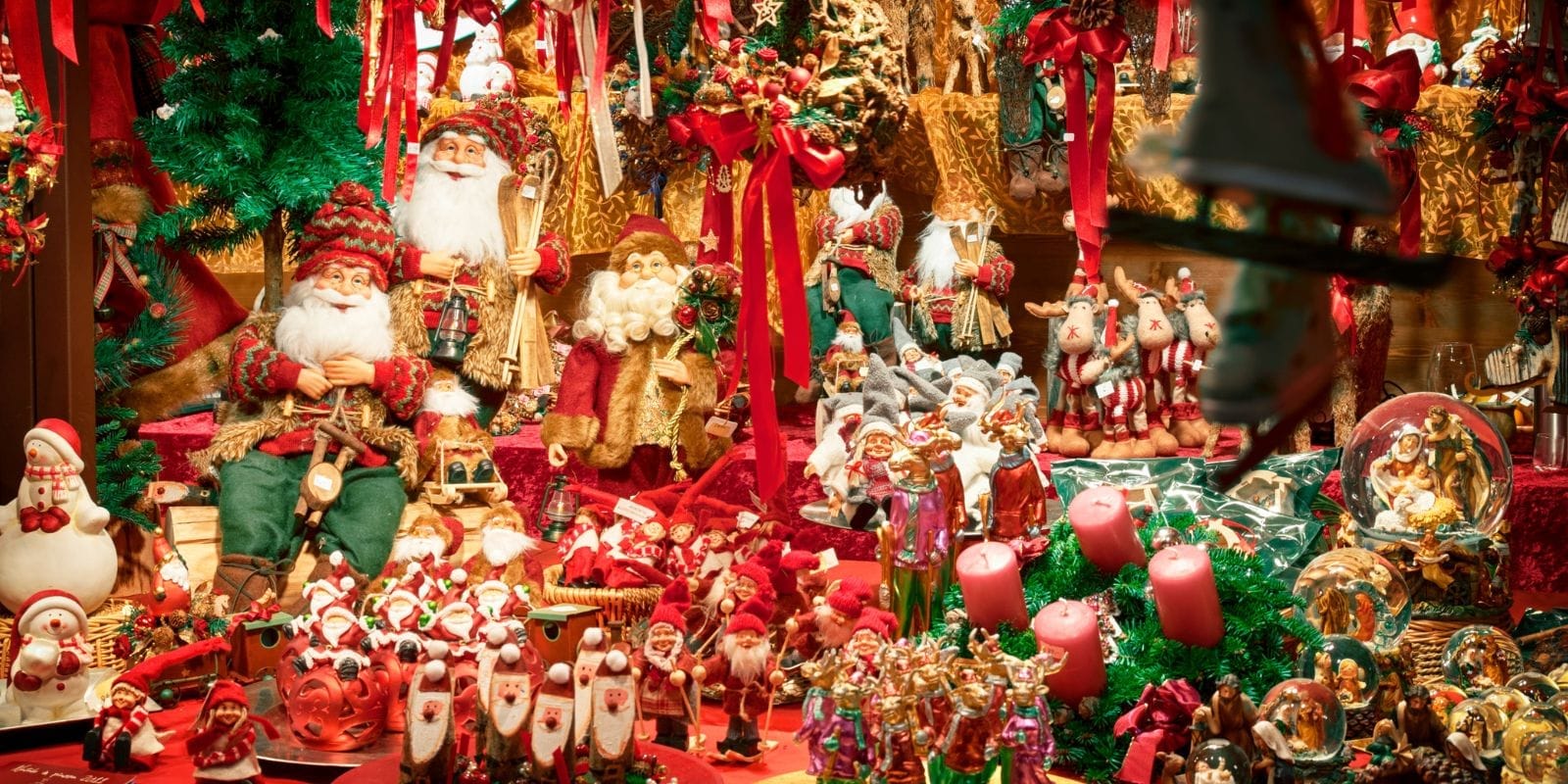
Things to buy. Good gifts include hand-carved wooden ornaments, nutcrackers, glass baubles, candle arches and Christmas pyramids. If you see something unusual, buy it, because the next town may not have it. For more ideas, see our guide to European souvenirs.
What a Christmas market trip costs
Entry to most markets is free, so food and accommodation make up most of the budget. As a guide:
- Glühwein: about €4 to €5 a cup, plus the mug deposit
- Sausage in a roll: about €6
- Small meal at a stall: about €10 to €15
- Central hotel during market season: from about €100 to €150 a night, more in popular cities and at weekends
Accommodation causes the biggest price differences. Hotels in Nuremberg, Munich and Cologne fill quickly. Staying near the main station of a smaller city, or in a nearby town, keeps costs down and makes day trips easier. For wider budgeting advice, see how to travel Europe on a budget.
Practical tips for visiting
Weather. December in Germany is cold and often wet, and it feels colder after a few hours outdoors. Wear layers, waterproof shoes, gloves and a hat. Our seasonal Europe packing list covers what to bring.
Payments. Card payments are widely accepted, but some stalls still take cash only. Carry small euro notes and coins. ATMs are easy to find in cities but less common in small towns. Check whether Apple Pay works abroad with your bank. If you plan to use a card, choose one of the travel cards without foreign transaction fees.
Safety. Security at German Christmas markets has increased since the 2024 attack in Magdeburg. Expect vehicle barriers, bag checks and a visible police presence at larger markets. A few small towns have cancelled their markets because of security costs, so check before travelling to a smaller one. Pickpockets operate in crowded markets, so keep your phone and wallet zipped away. For current advice, read is it safe to travel to Germany right now.
Timing. Weekday evenings give you the lights without the weekend crowds. Mornings are best for browsing crafts.
Stay connected between markets
A Christmas market trip depends on your phone more than you might expect. You'll use it for digital train tickets, delay alerts, platform changes, maps between squares and messages to the rest of your group. To plan your usage, see our guides to how much mobile data you need for travel and how much data Google Maps uses.
Jetpac eSIM for Germany lets you activate your plan before your flight or as soon as you land, without visiting a store or swapping SIM cards. It connects to local 5G networks across Germany. Essential apps such as WhatsApp, Uber and Google Maps keep working even after your main data allowance runs out. Jetpac also includes voice calling in the same app, with international calls to more than 50 countries, which is useful for calling hotels or drivers.
If your trip continues into Austria, Switzerland or France, Jetpac covers more than 200 destinations, so you can keep the same plan and avoid roaming charges. Before you buy, check whether your phone supports eSIM.
German Christmas market terms
A few German words make menus and signs much easier. For more about the country, see our fun facts about Germany.
Term | Meaning |
|---|---|
Weihnachtsmarkt | Christmas market |
Christkindlmarkt | Christmas market, used mainly in southern Germany |
Glühwein | Mulled wine |
Kinderpunsch | Non-alcoholic fruit punch |
Pfand | Deposit on your mug |
Lebkuchen | Spiced gingerbread |
Stollen | Fruit bread dusted with sugar |
Printen | Aachen's hard spiced gingerbread |
Reibekuchen | Potato fritters |
Feuerzangenbowle | Mulled wine with a flaming rum-soaked sugar cone |
FAQs
When do Christmas markets in Germany start in 2026? The first markets open in mid-November. Cologne's harbour market opens on 13 November and the cathedral market on 16 November. Most others open between 20 and 27 November.
When do German Christmas markets end? Most close on 23 December or at lunchtime on 24 December. Düsseldorf, Dortmund and Lübeck run until 30 December, Berlin's Gendarmenmarkt until 31 December, and the Rotes Rathaus market in Berlin until 3 January.
Which is the biggest Christmas market in Germany? It depends on how you measure it. Cologne's cathedral market reports more than four million visitors a year. Dortmund has more than 250 stalls across ten locations. Stuttgart and Leipzig each have around 300 stalls.
Which is the oldest Christmas market in Germany? Frankfurt dates its market to 1393, and Dresden's Striezelmarkt was first recorded in 1434. Both are among the oldest in the country.
Are Christmas markets in Germany free to enter? Most are. Rides and ice rinks are paid separately, and some castle markets charge an entrance fee. At Schloss Dyck near Düsseldorf, for example, the ticket also includes entry to the castle.
Can I visit several markets in one trip? Yes. Choose a region, base yourself in one or two cities, and take day trips by train. Cologne, Düsseldorf, Aachen and Dortmund are close enough to cover in a few days.
How much does Glühwein cost? Expect about €4 to €5 a cup, plus a mug deposit of €2 to €5 that you get back when you return the mug.
Do markets stay open in bad weather? Most stay open in rain or light snow. Individual stalls may close early in severe weather, so keep a few indoor options, such as museums and cafés, in mind.
Where else in Europe can I visit Christmas markets? Austria, the Czech Republic and the Alsace region of France all have strong market traditions, and some of their markets run past Christmas. Our guide to the best Christmas markets in Europe compares them.
Germany's markets reward a little planning: check the dates, choose a region, and leave room for at least one small town. If you're still deciding where to spend the holidays, our guide to the best places to go for Christmas covers more options.
Get connected as soon as you land with a Jetpac travel eSIM.