Do I Need a Visa for France From the USA? Complete Guide
U.S. citizens do not need a visa for France for short tourism or business trips under 90 days. Passport validity, Schengen day counts, ETIAS timing, and working mobile data keep the journey from the USA smooth.
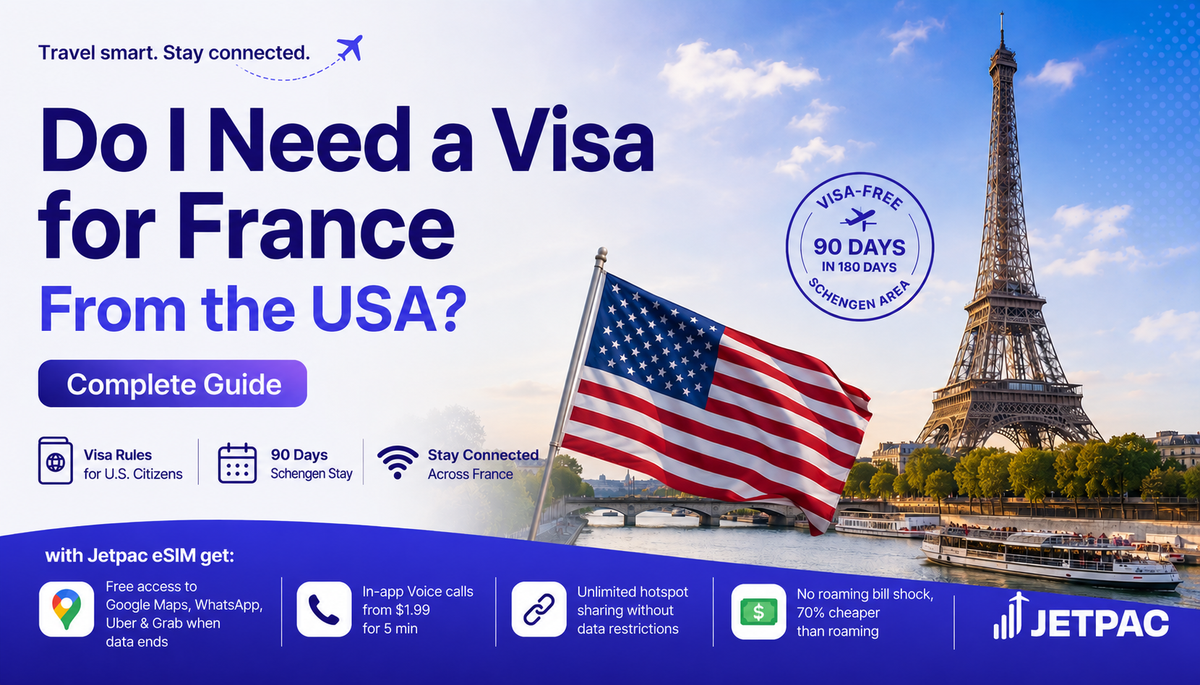
American travelers heading to France in 2026 have a clear starting point. Most U.S. tourists and business visitors asking do i need a visa for France will find the answer is no, a visa for France from the USA is not required for standard short stays under 90 days in any 180-day Schengen period.
Before departure, check passport validity, entry documents, and ETIAS timing, and set up a Jetpac eSIM so maps, bookings, and transport apps are live from the moment you land.
France visa rules for U.S. citizens
France is part of the Schengen Area, and short visits follow Schengen timing rules. U.S. citizens who travel to France for tourism or business generally stay up to 90 days in any 180 days without a short-stay visa.
The visa requirements for USA citizens in practice come down to one factor. When travelers ask do i need a visa to travel to France, the answer depends on whether the trip stays within the short-stay limit.
- Short stay: Tourism, family visits, or standard business meetings
- Stay limit: 90 days in any 180-day Schengen period
- Schengen counting: Days in France, Spain, Italy, Germany, and other Schengen countries all count together
- Long stay: More than 90 days typically requires a long-stay visa
- Trip purpose: Work, study, internships, and relocation all require separate checks
Documents to carry when entering France
Visa-free entry still requires presenting basic trip documents at border control. Keep offline copies saved in case airport Wi-Fi is unavailable after landing.
- Valid U.S. passport
- Return or onward flight ticket
- Hotel booking, rental address, or host details
- Proof of funds for the duration of the stay
- Travel insurance documentation
- Business, event, study, or family papers if relevant
When you travel to France from the USA, a Jetpac eSIM can help you open bookings, maps, and hotel details quickly, but offline copies remain the most reliable backup at the border.
Why this matters for U.S. travelers
The rules are simple but not optional. A passport validity gap, a complex multi-country itinerary, or an upcoming ETIAS change in late 2026 can affect plans well before the hotel check-in.
- Visa-free does not mean entry is guaranteed
- The 90-day limit applies across the entire Schengen Area, not per country
- Passport validity must be confirmed before buying flights
- ETIAS timing should be reviewed close to departure
- Even travelers focused on the best places to visit in France should verify entry rules before booking anything else
Before you travel to France, make sure your documents, tickets, and mobile data are organized and ready for day one.
Do I need a visa for France in 2026?
For most short holidays and business visits, no. U.S. passport holders can enter France without a short-stay visa when the stay falls within the 90-day Schengen limit. A visa for France from the USA is only required when the trip purpose or stay length goes beyond standard tourism or short business activity.
- No short-stay visa for most U.S. tourists
- No short-stay visa for most standard business visits
- Other Schengen country visits count toward the same 90-day total
- Border officers may ask for proof of stay, funds, and return travel
- Final entry approval rests with border control at the point of entry
If the trip is longer, paid, academic, or residence-based, confirm the correct visa category well before booking.
Quick Travel Requirements Snapshot
When do U.S. citizens need a visa for France?
A French visa is required when the trip falls outside short-stay tourism or business rules. The visa requirements for USA citizens change significantly when the purpose or length of stay goes beyond a standard holiday.
- Over 90 days: Apply for a long-stay visa before arrival
- Work: Obtain the correct work authorization before departure
- Study: Check the student visa route through the French consulate
- Internship or training: Confirm the appropriate category before booking
- Residence or relocation: Follow the long-stay national visa process
- Paid activity of any kind: Tourist entry is not sufficient
When travelers ask Do I need a visa to travel to France for a longer academic or work stay, the answer is yes, through the correct visa category before departure.
France visa vs ETIAS: what changes in 2026?
ETIAS is not a visa. It is a travel authorization for visa-exempt travelers and is expected to start in the last quarter of 2026.
- ETIAS is entirely separate from a French visa
- It applies only after the official EU launch date is confirmed
- It will be linked to the passport used during the application
- It covers short stays across 30 European countries, including France
- No action is needed until the EU announces the confirmed launch date
For travelers comparing France with other destinations, do Americans need a visa for Europe? The same Schengen 90/180-day framework follows across most popular destinations. Country-specific rules still apply for longer stays and non-tourism purposes.
Passport validity, minors, and pets
Your passport must be valid for at least three months beyond your planned departure from the Schengen Area. Six months of validity is the safer target because airlines and border officers can apply stricter checks than the stated minimum.
- Minimum three months of validity beyond your Schengen departure date
- Six months of remaining validity is recommended wherever possible
- Emergency or limited-validity passports issued at U.S. consulates abroad may face additional scrutiny at Schengen borders; confirm acceptability with the French consulate before relying on one for entry
- Minors: Carry notarized consent or custody documents when a child travels alone, with one parent, or with a non-parent adult
- Pets: France requires microchipping, a current rabies vaccination, and a USDA-endorsed health certificate; contact a USDA-accredited veterinarian well before departure
If the itinerary includes travel to France from the US alongside other Schengen countries, count every Schengen day carefully across the full route.
Also Read
Do Canadians Need a Visa for the USA?
Canada-to-U.S. travel has its own distinct entry rules that differ from the European Schengen framework. This guide explains ESTA, visa categories, and what documents cross-border travelers actually need to carry.
Can Americans Travel to Russia?
Learn the current entry requirements for U.S. citizens traveling to Russia. Find information on visas, travel restrictions, required documents, and important updates before your trip.
Do Americans Need a Visa for Europe?
Check whether U.S. citizens need a visa to visit Europe. Learn about visa-free travel, Schengen Area rules, entry requirements, and upcoming travel authorization changes.
Staying connected in France
A common question before departure is will my phone work in France, and the honest answer depends on your carrier, roaming plan, and whether your device supports eSIM. Mobile data matters in France because transport connections, hotel check-ins, restaurant bookings, and digital tickets all depend on a working connection from the moment you land.
- Check whether your phone is unlocked and eSIM-compatible
- Compare roaming day passes with a France eSIM plan to understand the real cost difference
- Install your data plan before the flight where possible
- Save passport copies, train tickets, and hotel details offline as a reliable backup
- Use an eSIM France plan for airport transfers, Metro routes, SNCF rail bookings, and same-day itinerary adjustments
For multi-country Schengen trips, comparing a France-only plan with the best eSIM for Europe travel option by coverage and data volume is worth the extra few minutes before departure. For most short holidays, the best eSIM for France is the one that installs cleanly before you fly and gives reliable data across every stop on the route.
France sits at the accessible end of international travel for U.S. visitors. Travelers who have researched whether Americans can travel to Russia know that active travel advisories, suspended commercial airline routes, and diplomatic restrictions make that an entirely different planning situation compared to a straightforward Schengen entry.
So do I need a visa for France? For most short U.S. visits in 2026, no, but that does not make preparation optional. Confirming passport validity, counting Schengen days, reviewing ETIAS timing, and sorting mobile data before flying from the USA are the steps that determine how smoothly the trip begins.
Why Jetpac eSIM works well for France trips
France travel moves quickly, especially after landing at Charles de Gaulle or Orly and needing to navigate the RER, catch a TGV connection, or locate a hotel across a busy terminal. Having data active from the arrivals hall removes the most stressful part of the first hour.
📍 Active before you exit French customs: Set up before the flight and arrive with maps, hotel directions, and booking apps already working. Paris airport-to-city transfers run on tight timing, and knowing your Metro line or transfer route before reaching the exit makes the first hour in France genuinely manageable.
🚆 Covers the full French transport network: SNCF booking confirmations, Metro service alerts, TER regional timetables, and ride-hailing apps across Paris, Nice, Lyon, Bordeaux, and Marseille all depend on consistent mobile data. One Jetpac plan handles every stop on a multi-city France itinerary from a single account.
📞 Call guesthouses, drivers, and local operators directly: Many smaller French guesthouses and private transfer drivers still prefer a direct phone call over app-based messages. Jetpac voice packs cover calls to local numbers in 50+ countries directly from Jetpac app, for $1.99 per 5 minutes, without a French SIM.
🔥 Share data with the whole travel group: Hotspot sharing works without data caps, so everyone travelling together has live maps and booking confirmations simultaneously, whether navigating a Paris arrondissement or boarding a train south to the coast.
💰 Save up to 70% compared with standard U.S. carrier roaming: Jetpac confirms pricing upfront before purchase with no bill surprises after returning from the USA. Standard U.S. carrier roaming rates in France add up quickly over a multi-day trip.
🌍 One plan for France and 200+ destinations worldwide: A Jetpac eSIM covers every French destination and carries forward to any onward Schengen or international stop without reconfiguring between countries.
✈️ Free lounge access when return flights are delayed: Jetpac users access over 1,300 airport lounges worldwide at no extra cost when a flight is delayed by more than one hour. Register yourself and one travel companion at least 24 hours before departure to activate.
🎧 24/7 support via WhatsApp and email: Available at any hour, whether a connection drops during a day trip to Versailles or a plan needs adjusting before an early morning TGV departure.

FAQs
Do I need a visa for France?
Usually no. U.S. tourists and business visitors can stay up to 90 days in any 180-day Schengen period without a short-stay visa.
Do I need a visa to travel to France?
For a short tourism or business trip under 90 days, most U.S. passport holders qualify for visa-free entry. Longer stays, paid work, and study require separate applications.
Do I need a visa to visit France?
For a standard holiday under 90 days, a valid U.S. passport is generally sufficient, provided all Schengen border requirements are met.
Do US citizens need a visa for France?
For short tourism or business visits within the 90-day Schengen limit, U.S. citizens generally do not need a Schengen short-stay visa.
Is ETIAS required for France in 2026?
Not yet. ETIAS is expected in the last quarter of 2026, and no action is needed before the official EU launch date is confirmed.
How long can U.S. citizens stay in France without a visa?
Up to 90 days in any 180-day Schengen period for tourism or business. This total includes all time spent across every Schengen country in the same window.
Can I work in France on a tourist visa?
No. Any form of paid work requires the correct work authorization and visa route arranged before arrival.
Disclaimer
This information is for general reference only. Entry rules, ETIAS timelines, passport requirements, and local conditions may change. Travelers should verify requirements with official French consulate pages, the U.S. State Department, and the official EU ETIAS site before booking or departure. Jetpac is not responsible for network variations or third-party data accuracy.