25 Amazing Fun Facts About Chile for Curious Travelers
Chile makes sense through its extremes, not trivia. Atacama stars, Rapa Nui moai, Patagonia wind, penguins, volcanoes, wine valleys, poetry, and seafood reveal a country shaped by distance and contrast.
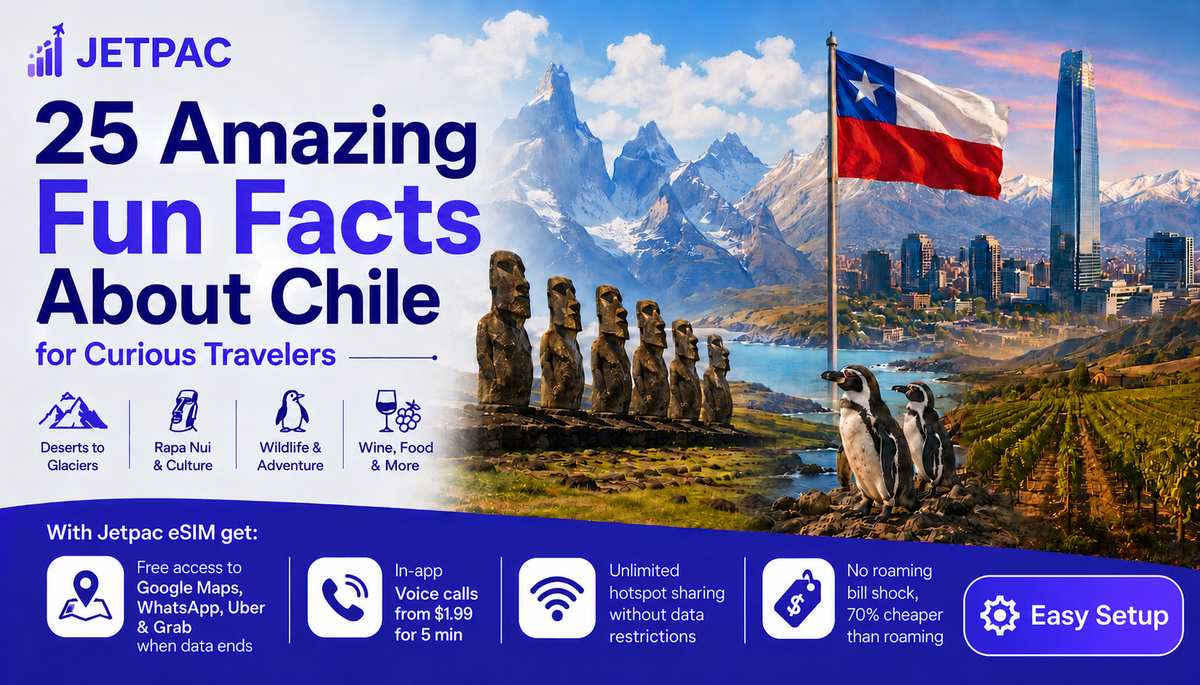
Chile is the kind of country where one trip can move from the driest desert on Earth to glaciers, volcanoes, wine valleys, penguins, island legends, and poetry-filled port cities. For travelers from the USA, these fun facts about Chile make route planning easier because Chile is long, varied, and full of surprises.
These amazing facts about Chile are written for curious travelers who want more than trivia. You will find interesting facts about the country of Chile, useful travel notes, and a few unique facts about Chile that can help you understand the destination before booking.
A Jetpac eSIM for Chile can also help with maps, hotel details, tour confirmations, and translations after arrival.
Before you go from the USA to Chile
U.S. tourist passport holders do not need a tourist visa for stays of 90 days or fewer. The U.S. Department of State says visitors receive a Tourist Card valid for up to 90 days and must return it on departure, so keep it safe.
- Arrival note: Santiago is the main international gateway for most U.S. routes
- Distance note: Domestic flights are often better than long bus routes between regions
- Connectivity note: A Chile eSIM is useful because desert tours, Patagonia routes, and airport transfers often depend on mobile data
Chile at a Glance
Interesting facts about Chile, South America
Chile, South America, fun facts are easier to remember when they connect to real places travelers can see, taste, or explore.
These interesting facts about the country of Chile show why distance, weather, culture, and geography all matter when planning a trip.
Landscapes that feel unreal
1. Chile feels like several countries in one
Chile stretches across deserts, valleys, forests, lakes, glaciers, islands, and fjords. That is why many fun facts about Chile start with geography.
- Experience it: Pair Santiago with Atacama or Patagonia
- Travel tip: Do not plan Chile like a small country
2. The Atacama is one of Earth's driest deserts
The Atacama Desert in northern Chile is known as one of the driest regions on Earth. Britannica describes it as a cool, arid desert approximately 1,000 km long.
- Experience it: Visit San Pedro de Atacama, the salt flats, and the moonlike valleys
- Travel tip: Pack lip balm, sunscreen, and plenty of water
3. Chile has some of the world's best stargazing
The Atacama's dry air, altitude, and clear skies make northern Chile a global astronomy hub. ESO calls Paranal Observatory one of the best astronomical observing sites in the world.
- Experience it: Book a stargazing tour near San Pedro
- Travel tip: Avoid full-moon dates for the darkest skies
4. The Atacama has helped space scientists
NASA tested rover and drilling technology in Chile's Atacama through its ARADS project because the terrain helps simulate Mars-like conditions.
- Experience it: Look for red rock, salt flats, and dry valleys on desert tours
- Travel tip: eSIM offers great connectivity for tour pickup times in remote towns where Wi-Fi is unavailable
5. Chile has an extreme climate variety
Chile's shape creates wild contrasts: northern desert, central vineyards, southern rainforests, and icy Patagonia. These are cool facts about Chile because they directly affect what you pack.
- Experience it: Combine city, desert, and national park days
- Travel tip: Bring layers even in summer
Islands, ice, and wildlife
6. Rapa Nui belongs to Chile
Rapa Nui, also called Easter Island, is a Chilean territory famous for its moai statues. UNESCO says Rapa Nui National Park reflects a unique Polynesian cultural tradition.
- Experience it: Visit Hanga Roa, Rano Raraku, and Ahu Tongariki
- Travel tip: Flights and park entry rules need planning
7. Chile has penguins in the wild
Chile is one of the easiest South American countries for seeing penguins in natural settings. The Humboldt Penguin National Reserve is also home to seabirds, marine otters, and humpback whales. Its accessible wildlife and island landscapes make Chiloé one of the best places to travel with kids who enjoy nature.
- Experience it: Look for penguins at Punta de Choros, Chiloé, or Punta Arenas
- Travel tip: Boat trips can be weather-dependent
8. Patagonia is shared with Argentina
Chilean Patagonia covers dramatic southern landscapes with fjords, glaciers, forests, and wind-shaped plains. This is one of the unique facts about Chile that matters for adventure planning.
- Experience it: Base yourself around Puerto Natales or Punta Arenas
- Travel tip: Chile eSIM is useful for weather checks before committing to hikes
9. Torres del Paine is a global hiking icon
Torres del Paine is known for granite towers, lakes, glaciers, and famous trekking routes. Its remote location means access by air, road, or bus needs planning well in advance.
- Experience it: Hike viewpoints or book multi-day circuits
- Travel tip: Reserve refugios and camps several months ahead
10. Chile reaches toward Antarctica
Chile's far south, particularly around Punta Arenas, sits close to Antarctic routes. These cool facts about Chile remind travelers how far the country extends beyond its northern desert.
- Experience it: Visit the Strait of Magellan area
- Travel tip: The weather can change extremely fast in the south
11. Chiloé is full of wooden churches and myths
Chiloé is known for misty islands, folklore, seafood, and wooden churches. UNESCO recognizes its churches for a unique wooden architecture tradition in Latin America.
- Experience it: Visit Castro, Dalcahue, and nearby islands
- Travel tip: Ferries and rural roads can slow your schedule
Cities, culture, and everyday life
12. Santiago has Andes views
On clear days, Santiago's skyline sits against the Andes in a way that catches visitors off guard. It is one of those details about Chile that photographs rarely capture fully.
- Experience it: Go to Sky Costanera or Cerro San Cristóbal
- Travel tip: Winter air pollution can reduce mountain visibility
13. Valparaíso is built on colorful hills
Valparaíso is a port city with steep hills, murals, and historic funicular lifts. UNESCO recognizes its historic quarter for industrial-age seaport heritage. Its compact walkable layout also makes it one of the perfect destinations for your first international trip if cultural immersion matters more than fast sightseeing.
- Experience it: Walk Cerro Alegre and Cerro Concepción
- Travel tip: Use licensed taxis or guided walks after dark
14. Chile has South America's tallest skyscraper
Gran Torre Santiago rises approximately 300 metres above the capital. Sky Costanera calls it the observatory of the tallest skyscraper in South America.
- Experience it: Visit the observation decks on a clear afternoon
- Travel tip: Clear afternoons give the strongest Andes views from above
15. Chilean Spanish has its own rhythm
Chilean Spanish sounds fast, with local slang and dropped sounds that can surprise even confident Spanish speakers. These fun facts in Chile become obvious when you order food or take a taxi.
- Experience it: Learn "po," "cachai," and "al tiro."
- Travel tip: Translation apps help in smaller towns and markets
16. Chile has a strong poetry legacy
Chile gave the world Nobel laureates Pablo Neruda and Gabriela Mistral. Their homes and museums add genuine depth to any cultural route through Santiago or Valparaíso.
- Experience it: Visit La Chascona in Santiago or Neruda sites in Valparaíso
- Travel tip: Book museum slots where reservations are available
17. Chilean food is comforting and local
Chilean food includes pastel de choclo, empanadas, seafood, cazuela, and the completo hot dog. These amazing facts about Chile are tastiest when experienced in local markets and coastal restaurants.
- Experience it: Try fresh seafood in coastal cities
- Travel tip: Lunch menus are often significantly better value than dinner
More interesting facts about Chile, South America
18. Chile had the largest earthquake ever recorded
The 1960 Valdivia earthquake is listed by USGS as magnitude 9.5. This is one of the most serious fun facts about Chile because it explains why earthquake awareness matters near coastal areas.
- Experience it: Learn local evacuation signs near the coast
- Travel tip: Keep emergency alerts and offline maps accessible
19. The Chinchorro mummies are older than many famous mummies
UNESCO recognized the Chinchorro Cultural Complex in northern Chile in 2021 for some of the world's oldest known artificial mummification practices.
- Experience it: Visit Arica and regional museums
- Travel tip: Check opening days before planning a visit
20. Chile has many active volcanoes
Chile sits along the Pacific Ring of Fire with one of the longest volcanic chains in the world. The Smithsonian Global Volcanism Program maintains records on Chilean volcano activity.
- Experience it: See Villarrica, Osorno, or Licancabur
- Travel tip: Follow official alerts when near active volcano areas
21. Chile is a major wine destination
Central Chile's valleys near Santiago, Valparaíso, and the coast produce internationally recognized wines. Maipo, Casablanca, and Colchagua are among the most visited wine regions.
- Experience it: Tour vineyards in any of the central valleys
- Travel tip: Arrange transportation before tastings
22. The Andes shape daily life
The Andes influence Chile's weather, scenery, skiing, water supply, roads, and city views. Santiago frames the mountains as a daily backdrop from most neighborhoods.
- Experience it: Add Cajón del Maipo or Valle Nevado for mountain day trips
- Travel tip: Mountain roads may need extra travel time
23. Chile has a huge Pacific coastline
Chile's coastline spans 6,435 km according to CIA World Factbook data, making it one of the longest in South America, with an enormous variety from surf towns to fishing villages.
- Experience it: Visit Valparaíso, Pichilemu, or La Serena
- Travel tip: eSIM helps with coastal navigation and ride apps
24. Chile's flag is often compared with Texas's
Chile's flag and the Texas flag look similar because both use red, white, blue, and a single white star against a blue canton. For U.S. travelers, it is one of the most visual first surprises. Santiago's walkable neighborhoods and Patagonia's open trails also make Chile one of the best places to travel solo among South American destinations.
- Experience it: Notice the flags in airports, plazas, and stadiums
- Travel tip: The two flags have entirely different historical origins
25. Chile rewards curious travelers
The best fun facts about Chile are not just facts. They become real when you see desert stars, hear port-city music, taste seafood, and feel Patagonia wind. Chile consistently ranks among the best summer vacations for families seeking varied landscapes and well-organized infrastructure across wildly different regions.
- Experience it: Build a route around the contrast between regions
- Travel tip: Leave buffer days for weather and distances
Also Read
Fun Facts About Costa Rica
Costa Rica holds some genuinely surprising natural and cultural records worth knowing before a visit. This guide covers wildlife, lifestyle, and the small details that make the country feel special.
Fun Facts About Puerto Rico
Puerto Rico combines island culture, colonial history, food, and surprising geography in ways that reward curious travelers. This guide covers the facts most visitors only discover after they arrive.
Fun Facts About Texas
Texas holds its own set of surprising records and local stories that many people outside the state have never heard. This guide covers them in a quick, easy-to-read format.
Fun Facts About Colombia
Colombia's regional variety, cultural depth, and travel scene have grown significantly and reward curious planning. This guide covers the facts and travel inspiration you should know before your first South American trip.
Interesting Fun Facts About Argentina
Argentina is full of surprising contrasts, from world-famous natural wonders and unique wildlife to cultural traditions that shape daily life. This guide highlights fascinating facts that many visitors don't discover until they explore the country for themselves.
How Jetpac helps in Chile
Traveling across Chile is different from staying in one city. You may land in Santiago, fly north to the desert, reach Patagonia by bus, join early morning tours, or cross stretches where public Wi-Fi is simply not available. These fun facts about Chile paint the picture of a destination that rewards practical preparation as much as curiosity.
📍 Connected from the moment you clear arrivals in Santiago: Install before your flight and land at Arturo Merino Benítez Airport with maps, hotel addresses, and driver contacts already active. First-day logistics in Chile depend on quick access to navigation and ride apps from the terminal exit.
🏜️ Works across desert, Patagonia, and everything between: Chile's geography means a single trip can move from a coastal city to a remote desert tour to a Patagonian trailhead. With eSIM Chile, data follows you through each region without needing a new SIM at every stop.
📞 Call tour operators and local contacts directly: Many operators in San Pedro de Atacama, Punta Arenas, and rural Patagonia work primarily through direct phone calls. Jetpac voice packs cover calls in 50+ countries directly from a Jetpac App for $1.99 per 5 minutes, without a local Chilean SIM.
🔥 Share data with your whole travel group: Whether navigating Santiago's Metro or coordinating a Torres del Paine shuttle, hotspot sharing works without data caps so everyone has live navigation and booking access simultaneously.
💰 Save compared with standard U.S. carrier roaming: An eSIM for Chile from Jetpac confirms pricing upfront before purchase. Travelers typically save up to 70% compared with standard U.S. carrier rates, with no surprise roaming charges after returning home.
🌍 One plan for Chile and 200+ destinations worldwide: A Jetpac eSIM works in every Chilean city and region and carries forward to any onward South American or international destination without reconfiguring.
✈️ Free lounge access when return flights are delayed: Jetpac users access over 1,300 airport lounges worldwide at no extra cost when a flight is delayed by more than one hour. Register yourself and one travel companion at least 24 hours before departure to activate.
🎧 24/7 support via WhatsApp and email: Jetpac’s team is reachable at any hour, whether a connection drops during an Atacama tour or a route change is needed before an early Patagonia departure.

FAQs
What are the most surprising facts about Chile?
The Atacama's extreme dryness, Rapa Nui's moai, Patagonia's wild weather, the Chinchorro mummies' age, and the 1960 magnitude 9.5 earthquake are among the most surprising.
Is Chile easy for U.S. travelers?
Chile is manageable, but distances are large, and some regions are remote. Plan domestic flights between regions, check safety updates, and keep your Tourist Card safe for departure.
What should travelers pack for Chile?
Pack layers, sunscreen, comfortable walking shoes, a plug adapter, and weather-ready clothing. Desert, city, coast, and Patagonia conditions differ significantly across the country.
Are these facts useful for trip planning?
Yes. They help travelers understand distances, climate differences, regional culture, and the kind of experiences that make Chile a genuinely memorable destination.
Disclaimer
Travel rules, safety conditions, attraction access, park regulations, flight routes, tour availability, and weather can change at any time. Before booking or visiting, travelers should check official sources such as the U.S. Department of State, Chilean tourism bodies, national park authorities, attraction websites, and local operators for the latest updates.