
20 Fun Facts About the Philippines That Will Blow Your Mind
Discover what makes the Philippines a must-visit place, from 7,641 islands and rare wildlife to rich traditions and food. Explore 20 interesting facts that help you plan your next trip better.
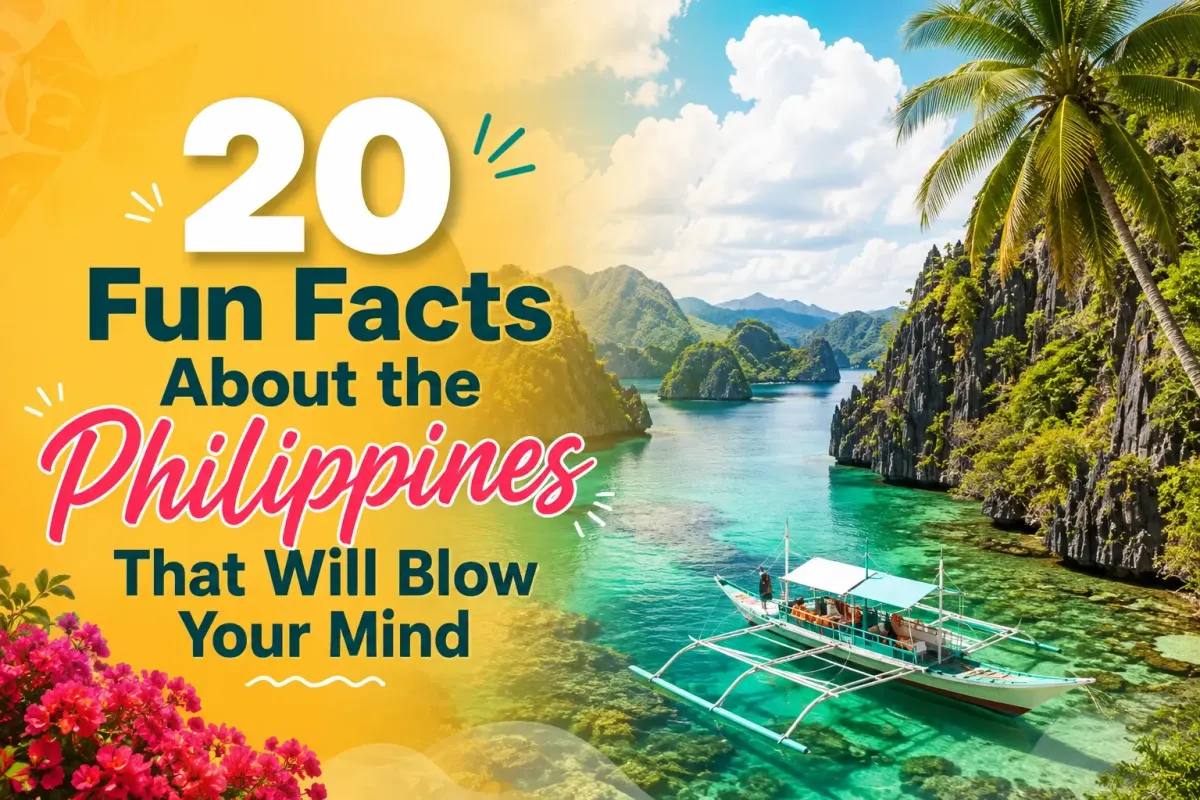
The Philippines is one of Southeast Asia's most extraordinary destinations, a vast archipelago of more than 7,600 islands celebrated for pristine beaches, world-class marine biodiversity, vibrant cultural festivals, and a warmth toward visitors that is genuinely hard to find elsewhere.
This guide covers 20 fun facts about the Philippines that go well beyond standard tourist information, from rare wildlife and geological wonders to colonial history and food traditions.
These interesting facts about the Philippines' geography, culture, and everyday life offer a richer perspective on one of Asia's most rewarding travel destinations in 2026.
These fast facts about the Philippines set the stage for the deeper exploration below.
Geography and nature
Some of the most fun facts about the Philippines involve its geography, which spans record-breaking coastlines and geological wonders shaped over millions of years.
1. The Philippines has more than 7,600 islands
The Philippines officially comprises 7,641 islands, a count that has been refined as satellite mapping technology has improved. Only around 2,000 are inhabited, spanning three main groups: Luzon in the north, the Visayas in the center, and Mindanao in the south.
2. It is home to one of the world's longest coastlines
With approximately 36,289 km of coastline, the Philippines ranks among the longest in the world. This extraordinary shoreline is among the most unique facts about the Philippines' geography, supporting reef diving, inter-island ferry culture, and globally photographed beaches across the archipelago.
3. The Chocolate Hills are not made of chocolate
The Chocolate Hills of Bohol Province are on the Philippines Tentative List for UNESCO World Heritage consideration, featuring approximately 1,268 symmetrical limestone mounds. During the dry season, their grass turns brown, creating the now-famous visual. This geological phenomenon is one of the most cool facts about the Philippines' natural landscapes.
4. The Philippines is one of the world's biodiversity hotspots
The Philippines is one of 36 globally recognized biodiversity hotspots and one of only 17 mega-biodiverse countries. It holds approximately 5 percent of the world's known species within less than half a percent of its land area, making this one of the most important facts about the Philippines' conservation significance worldwide.
Read more: Australia shares the Philippines' extraordinary reputation for rare wildlife and record-breaking natural geography. This guide covers 15 of the most fascinating and lesser-known facts about Australia. Read our blog 👉 15 Fun Facts About Australia That Will Amaze and Surprise You

Wildlife and nature
5. The Philippine Eagle is one of the world's largest eagles
The Philippine Eagle has a wingspan reaching up to 2.2 meters (7.2 feet) and is critically endangered, with fewer than 800 individuals estimated to remain in the wild. Active conservation programs in Mindanao represent some of Southeast Asia's most urgent wildlife protection work.
6. Tarsiers are among the world's smallest primates
The Philippine tarsier measures just 10 to 15 cm in body length and cannot rotate its fixed eyeballs, turning its entire head up to 180 degrees to see instead. Bohol's tarsier sanctuaries attract wildlife enthusiasts globally and rank among the most interesting facts about Philippine fauna for animal-focused travelers.
7. The country has incredible coral reef diversity
The Philippines sits within the Coral Triangle, the planet's center of marine biodiversity, with over 2,000 fish species recorded in its waters. Tubbataha Reefs Natural Park, a UNESCO World Heritage Site inscribed in 1993, is among the most celebrated fun facts about the Philippines for diving enthusiasts and marine conservationists worldwide.
Read more: Japan's natural wonders, ancient traditions, and cultural contrasts reveal a far richer story than most travelers expect. This guide covers 20 of the most compelling and often surprising facts about Japan. Read our blog 👉 20 Fun Facts About Japan You Probably Didn't Know
Culture and traditions
8. English is widely spoken
With approximately 90 million English speakers, the Philippines is widely considered the third largest English-speaking country in the world. English is an official language used in government, education, and business throughout the archipelago, making it one of the most unique facts about the Philippines travel accessibility for American visitors specifically.
9. Filipinos celebrate some of the world's biggest festivals
Sinulog in Cebu City draws millions each January to honor the Santo Niño with elaborate costumes and street dancing. Ati-Atihan in Kalibo, Aklan Province, is considered the oldest festival in the archipelago, also held in January. MassKara Festival fills Bacolod City with smiling mask performances each October, making these three among the most cool facts about Philippine cultural life.
10. Hospitality is a national characteristic
Filipino hospitality, expressed locally as "malasakit" (genuine care for others), is among the most important information about the Philippines that travelers experience immediately on arrival. Guests are treated as honored visitors and offered the best available food, even when resources are modest.
11. Karaoke is almost a national hobby
Singing machines appear in Filipino homes, restaurants, parks, and on inter-island ferries. The Philippines is widely credited with developing the videoke machine in the 1980s, adding music video screens to the karaoke format, and this remains one of the most memorable fun facts about Philippines pop culture.
Read more: China's ancient civilization, modern achievements, and cultural complexity continue to surprise even experienced international travelers. This guide covers 25 fascinating facts about China for curious visitors. Read our blog👉 25 Fun and Interesting Facts About China for Travelers
Food facts
12. Every region has its own signature dish
Regional food variety is one of the most compelling fun facts about Philippine culture for culinary travelers. Adobo (vinegar and soy-braised meat), sinigang (tamarind-sour soup), and lechon (whole roasted pig) anchor national cuisine, while the lechon of Cebu and Manila taste distinctly different, sparking devoted regional loyalties.
13. Halo-halo is unlike any other dessert
Halo-halo (meaning "mix-mix") layers shaved ice, evaporated milk, sweetened beans, tropical fruit jellies, ube (purple yam) ice cream, and leche flan in a single glass. No two servings are identical.
It is one of the most unique facts about Philippine food culture that visitors consistently remember long after returning home.
History
14. The Philippines was ruled by three different nations
Spain governed the Philippines for more than 333 years from 1565 to 1898, leaving deep Catholic traditions and baroque churches now recognized on the UNESCO World Heritage List. The United States administered the country from 1898 to 1946, introducing English-language public education.
Japan occupied the Philippines from 1942 to 1945, and these colonial layers are among the most important facts about the Philippines' national identity.
15. It was the first Southeast Asian country to gain formal independence after WWII
On July 4, 1946, the Philippines received internationally recognized independence from the United States, becoming the first Southeast Asian nation to achieve formally recognized sovereignty from a colonial power after World War II.
These are significant fast facts about the Philippines for anyone studying postwar Asian political history. June 12 marks Philippine Independence Day, commemorating the 1898 declaration from Spain.
Read more: Canada's geographic scale, Indigenous cultural diversity, and modern multicultural cities consistently hold surprises for visitors who look beyond the surface. This guide covers 20 fascinating and often overlooked facts about Canada. Read our blog👉 20 Interesting and Fun Facts About Canada You Didn't Know
Amazing records
The Philippines has earned some remarkable global records, and these three are among the most cool facts about the Philippines' recognition on the world stage.
16. The Philippines produces some of the world's largest pearls
The Pearl of Lao Tzu, found off Palawan in 1934, weighed approximately 6.4 kg and held the title of world's largest known natural pearl for decades. In 2016, a Filipino fisherman in Palawan reportedly found a much larger formation estimated at approximately 34 kg.
These are among the most interesting facts about the Philippines' natural history for gemstone enthusiasts.
17. It has some of the world's best diving sites
Coron in Palawan ranks among the world's premier WWII shipwreck diving destinations, with visibility and preservation that attract divers from every continent. Apo Island in Negros Oriental is globally recognized for its community-led coral recovery and resident marine turtle population.
18. Jeepneys are one of the world's most unique public transport systems
Jeepneys evolved from US military vehicles left after WWII and became enduring symbols of Filipino creativity and cultural identity. Elaborately painted with religious imagery and folk art, they are one of the most unique facts about the Philippines' everyday life that visitors encounter from the moment they arrive in any city.
Read more: Mexico's ancient ruins, natural diversity, and vibrant living traditions hold far more depth than most travelers anticipate. This guide covers 20 of the most compelling and lesser-known facts about Mexico. Read our blog👉Top 20 Fun Facts About Mexico: Hidden Gems, Culture & Nature
Everyday life
19. Filipinos spend more time online than almost anyone else
The Philippines consistently ranks among the world's highest nations for daily internet and social media engagement. According to the DataReportal Philippines 2026 Digital Report, Filipinos average over 8 hours of daily internet use, with Facebook, TikTok, and YouTube maintaining some of their most engaged global audiences in the country. These are among the most interesting facts about the Philippines modern society.
20. Family plays a central role in Filipino society
Multi-generational households are common across the Philippines, with grandparents, parents, and children regularly sharing a home and daily life. The concept of "bayanihan" (communal solidarity) extends beyond the family unit to entire neighborhoods and communities. These are among the most important facts about the Philippines social values that shape everyday decisions across all generations.
Read more: Colombia's extraordinary diversity of landscapes, cultures, and vibrant energy continues to inspire travelers who discover it for the first time. This guide covers 20 compelling and often surprising facts about Colombia. Read our blog👉 Discover 20 Fun Facts about Colombia to Inspire Your Next Trip
What is the Philippines best known for?
What is the Philippines known for on the global stage? The most common answers center on beaches and diving, but some of the most fun facts about the Philippines reveal a country far richer than its coastlines alone suggest.
The Philippines is celebrated for its 7,641 islands, its place within the Coral Triangle, and festivals like Sinulog that draw millions annually. Its landscapes span the UNESCO-listed Banaue Rice Terraces to the limestone formations of El Nido, covering some of the most cool facts about the Philippines natural beauty that draw repeat visitors.
It is one of Asia's most English-fluent nations and one of the cheap places to travel in Asia, delivering world-class experiences at accessible price points.
What is the Philippines known for among travelers returning for a second visit? It consistently involves cultural depth, bayanihan spirit, and regional food diversity that some of the best fun facts about the Philippines' history and culture only begin to capture.
Some visitors research pocket Wi-Fi Philippines options versus Philippines eSIM plans before departure for multi-island connectivity. Knowing this important information about the Philippines' digital landscape helps travelers plan more confidently. These fun facts about Philippines wildlife, food, and cultural traditions form a compelling case for any curious traveler's bucket list.
These fast facts about the Philippines across geography, history, and society confirm why it ranks consistently among Asia's most rewarding destinations.
Stay connected while exploring the Philippines
Booking inter-island ferries, navigating between islands, and checking real-time transport updates all require reliable mobile data throughout a Philippines trip.
Jetpac's eSIM Philippines plan installs on your phone before departure and connects automatically on landing across 4G and 5G networks nationwide. For travelers covering Luzon, the Visayas, and Palawan, a Philippines eSIM means uninterrupted connectivity without sourcing local SIMs at each new destination.
The best eSIM for Philippines travel should cover both major urban centers and more remote island areas. Jetpac includes unrestricted hotspot sharing, 24/7 WhatsApp support, and a 100% money-back guarantee for seamless island-to-island connectivity.

FAQs
What is the Philippines best known for?
The Philippines is known for its 7,641 islands, world-class diving in the Coral Triangle, vibrant festivals like Sinulog and MassKara, exceptional hospitality, and iconic dishes including adobo and halo-halo.
Why does the Philippines have so many islands?
The Philippine archipelago formed through millions of years of volcanic activity and tectonic movement along the Pacific Ring of Fire, creating 7,641 islands across three main geographic groups.
What are the most interesting facts about the Philippines?
Key highlights include its status as one of 17 mega-biodiverse countries, the geological Chocolate Hills of Bohol, the critically endangered Philippine Eagle, Tubbataha Reefs Natural Park, and record-breaking pearls found off Palawan.
What language do most Filipinos speak?
Most Filipinos speak Filipino (based on Tagalog) and English, both official languages. The Philippines is widely regarded as the third largest English-speaking country in the world, with approximately 90 million English speakers.
What is the national animal of the Philippines?
The Carabao (water buffalo) is the national animal. The Philippine Eagle is the critically endangered national bird, with fewer than 800 individuals estimated to remain in the wild.
What foods are unique to the Philippines?
Halo-halo, adobo, sinigang, and lechon are among the most distinctively Filipino dishes, with preparation and flavor varying considerably by region across the archipelago.
Why is the Philippine Eagle so famous?
The Philippine Eagle has a wingspan of up to 2.2 meters and is one of the largest eagles on earth. Its critically endangered status and active conservation programs in Mindanao make it a national symbol of environmental responsibility.
Can I use an eSIM while travelling around the Philippines?
Yes. An eSIM Philippines plan from providers like Jetpac activates before departure and works across major islands and tourist destinations, removing the need to purchase a local SIM on arrival.
Disclaimer
The information contained within this blog was accurate at the time of original publication. All information reflects data available as of 2026. Verify current entry requirements, conservation rules, and travel conditions before visiting the Philippines. Jetpac is not responsible for any changes found after publication.